
Water Filter vs Water Conditioner: What South African Homeowners Need to Know

If you’ve been shopping for a water filter to deal with the chalky white residue building up on your taps, showerhead, and kettle, you’re not alone. Thousands of South African homeowners type those exact words into Google every month. But here’s the thing: a water filter and a water conditioner solve fundamentally different problems. Understanding that difference before you buy could save you a considerable amount of money – and a great deal of frustration.

In this guide, we break down exactly what each solution does, where each one falls short, and why a growing number of South African homeowners are turning to a water conditioner instead.

What Does a Water Filter Actually Do?

A water filter is designed to remove things from your water. Depending on the type, it might reduce chlorine, bacteria, heavy metals, sediment, or other contaminants. Carbon block filters, reverse osmosis systems, and jug-style filters all work on this principle: they physically trap or absorb unwanted particles as water passes through a filtration medium.

For improving the taste or safety of your drinking water, a good filter does a reliable job. However, filters have a specific and important limitation – they require regular maintenance. Cartridges need replacing, membranes can clog, and if you forget to service them on schedule, performance drops off quickly.

Moreover, a standard water filter is not designed to tackle limescale. Limescale is caused by calcium carbonate – a naturally occurring mineral that is perfectly safe to drink but becomes problematic when it builds up on heating elements, taps, and pipes. Filtering calcium carbonate out of your water would require a highly specialised (and expensive) system, and even then, you’d be stripping out the very minerals that make hard water nutritionally valuable.

The Real Culprit in Most South African Homes: Hard Water and Limescale

South Africa is a predominantly hard water country. Regions including Limpopo, Mpumalanga, Gauteng, the Western Cape, and the Cape West Coast all have high mineral content in their water supply. As rainwater travels through rock and soil to reach our reservoirs, it picks up calcium and magnesium – which is actually good for your health, but less ideal for your home.

The problem arises when these minerals precipitate out of the water and bond onto surfaces. Just 3mm of limescale on a geyser element forces it to use at least 21% more energy to heat the same volume of water. Multiply that across your appliances – your washing machine, dishwasher, kettle, and showerheads – and the cost adds up fast. South African homeowners in hard water areas can lose the equivalent of R11,000 per year in energy alone.

This is a limescale problem, not a contamination problem. And that’s a crucial distinction, because a water filter cannot solve it.

What Is a Water Conditioner – and How Is It Different?

A water conditioner works at a molecular level rather than through physical filtration. Instead of removing minerals from your water, it changes the way those minerals behave. Specifically, it alters the structure of calcium carbonate so that it can no longer cling to surfaces and form the hard, crusty deposits we call limescale.

The Halcyan Water Conditioner, for example, uses a patented alloy of 12 metals cast into a compact unit that installs directly onto your incoming mains pipe. As water flows through, it passes over the alloy core, creating a galvanic reaction that restructures the calcium carbonate molecules. The result? The minerals stay in your water – contributing to your health – but they lose their ability to bond to your pipes, geyser element, taps, or any other surface.

Furthermore, existing limescale gradually dissolves over time as the re-engineered water flows through your system. Customers typically notice a visible reduction in build-up within a few weeks of installation.

Water Filter vs Water Conditioner: A Side-by-Side Comparison

To make the comparison clear, here’s how the two solutions differ across the most important criteria:

Feature Water Filter Halcyan Water Conditioner
Tackles limescale No Yes – removes and prevents
Removes contaminants Yes No (not its purpose)
Retains healthy minerals Depends on type Yes – always
Requires maintenance Yes – regular cartridge replacement No – fit and forget for 30+ years
Uses electricity or chemicals Sometimes Never
Impact on water pressure Can reduce Negligible (4.27 PSI drop)
Eco-friendly Partially Fully – zero chemicals, zero power
Warranty Varies 30-year manufacturer’s warranty
Money-back guarantee Varies 12-month performance guarantee


Why More South African Homeowners Are Choosing a Water Conditioner

For homeowners dealing specifically with limescale – rather than a contamination concern – the Halcyan Water Conditioner offers a more complete and more permanent solution than any water filter on the market. It installs once, requires no ongoing maintenance, uses no electricity, and adds nothing artificial to your water.

Additionally, the savings are real and measurable. On average, South African households save approximately R10,000 per year across energy costs and cleaning products once limescale stops building up throughout their system. Over the lifetime of the unit – which carries a 30-year warranty – that figure becomes compelling.

It is also worth noting what the Halcyan does not do: it does not soften your water by removing minerals in the way a salt softener would. Your water remains healthy and mineral-rich; it simply behaves differently. As a result, you can drink from every tap in your home without any concern. The unit holds full WRAS certification – the international standard for drinking water equipment.

For households that do have a specific contamination concern alongside a hard water problem, the good news is that the two solutions are complementary. A water conditioner can actually protect and extend the life of any filter you have installed, because limescale no longer builds up around the filter housing or cartridge.

Frequently Asked Questions

  1. Can a water filter remove limescale from my pipes and appliances?

A standard water filter cannot remove limescale already in your system, nor can it prevent new build-up. Limescale is caused by calcium carbonate bonding to surfaces – a physical and chemical process that filtration alone does not address. A water conditioner is specifically designed to reverse and prevent this process.

  1. Is a water conditioner the same as a water softener?

No. A water softener removes calcium and magnesium from your water using salt or resin, which means you typically cannot drink the water from every tap and must add salt regularly. A water conditioner retains all the natural minerals in your water but changes their molecular structure so they cannot form limescale. It requires no salt, no chemicals, and no maintenance.

  1. Will a water conditioner improve the taste of my water?

The Halcyan Water Conditioner does not alter the chemical composition of your water, so technically the taste should remain the same. However, many customers report that water feels and tastes better after installation – likely because of the improved texture and the absence of dissolved limescale particles. If your primary concern is taste or a specific contaminant, a filter jug used alongside your conditioner is a practical solution.

  1. How long does it take for a water conditioner to remove existing limescale?

The timeline varies depending on how long limescale has been building up and where it is located. Most customers notice a visible difference within a few weeks, particularly on showerheads and taps. In pipes and geyser elements, the process can take a few months. Because the Halcyan comes with a 12-month performance guarantee, you have ample time to observe results before committing permanently.

  1. Is the Halcyan Water Conditioner safe to drink from?

Absolutely. The Halcyan holds WRAS certification – the same international standard applied to any equipment installed into a drinking water supply. The unit adds nothing to your water and removes nothing from it. Your water quality report will be identical before and after installation; the only change is in how the minerals behave once they enter your home.

Ready to Solve Your Hard Water Problem for Good?

If you’ve been searching for a water filter and what you’re really dealing with is a limescale problem, a Halcyan Water Conditioner is likely the better solution. It installs in under an hour, requires no upkeep, and comes backed by a 30-year warranty and a 12-month performance guarantee.

Whole house units start from R21,982 including VAT, with next-business-day delivery to most areas across South Africa.

Visit our shop or call us on +27 82 789 1076 to speak with our team. We’re happy to help you find the right unit for your home – and to answer any questions about water treatment in South Africa.


Learn More
Limescale Remover: What Works, What Does Not, and the Fix That Ends the Cycle for Good

If you have ever stood scrubbing a chalky white crust off your tap, watched your kettle element disappear under a layer of concrete-like scale, or noticed your showerhead losing pressure month by month, you already know the limescale problem well. What you might not know is just how much it is costing you.

South Africa has some of the hardest water in the world. Regions like Limpopo, Mpumalanga, Gauteng, the Western Cape, Cape West Coast, and the Eastern Cape are particularly affected. Hard water is not a health hazard; in fact, it contains valuable minerals like calcium and magnesium that are good for your body. However, those same minerals leave behind calcium carbonate deposits on every surface your water touches, and that build-up is quietly driving up your energy bills every single month.

Research shows that just 3mm of limescale on a geyser element forces it to work at least 21% harder than a clean one. Every additional millimetre adds roughly 7% to your energy consumption, unnecessarily. For the average South African household, that translates to thousands of rands in wasted energy each year.

So what is the best limescale remover for your home? The answer depends on whether you want a short-term fix or a permanent one.

The Most Common Limescale Remover Options

  1. White vinegar and citric acid

The go-to DIY limescale remover for most households. Both are mildly acidic and work by dissolving the mineral bonds that cause calcium carbonate to cling to surfaces. White vinegar is widely available and cheap. Citric acid, found in most supermarkets or pharmacies, is slightly stronger and less pungent to work with.

For kettles, fill with a diluted solution, bring to the boil, and leave to cool before rinsing well. For showerheads and tap fittings, soaking in a bag of vinegar or citric acid solution for 30 to 60 minutes usually shifts moderate build-up effectively.

The honest limitation is that these solutions only reach what you can see. The scale building inside your pipes, on your geyser element, and inside your washing machine drum continues to accumulate, untouched.

  1. Commercial descaling products

Products formulated specifically as a limescale remover, such as Calclean and similar brands, use stronger acid concentrations to tackle heavier deposits on appliances. They can be effective on kettles, coffee machines, and washing machines when used correctly and regularly.

The trade-off is ongoing cost and chemical usage. These products introduce acids and other compounds into your drainage system with every application. More importantly, because they address the deposit rather than the cause, limescale returns reliably after each treatment. You are managing the problem, not solving it.

  1. Mechanical removal

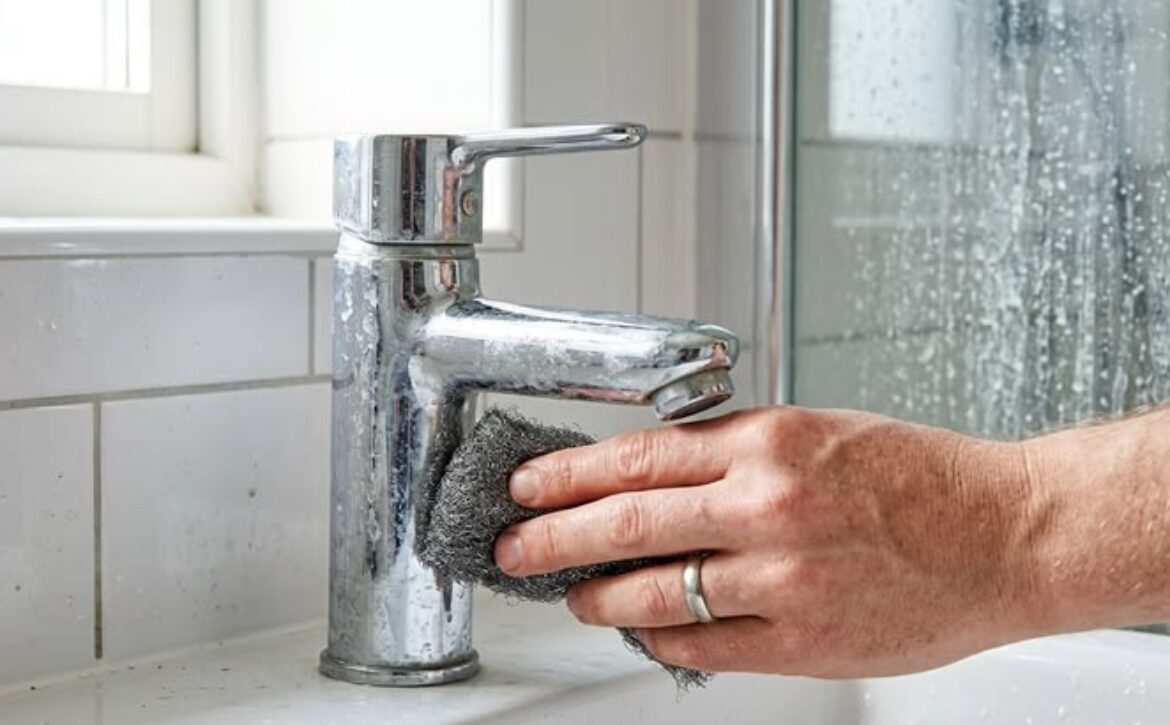
For stubborn limescale on tiles, shower screens, and bathroom surfaces, some homeowners use scrapers, specialist lime pads, or fine steel wool. These can shift heavy scale that chemicals cannot fully dissolve, but they carry a real risk of scratching chrome, glass, and ceramic finishes if used without care.

Like all reactive approaches, mechanical removal is purely a catch-up exercise. It has no effect on the scale you cannot reach.

  1. Salt-based water softeners

A salt softener is the most comprehensive limescale remover available in the traditional sense. It eliminates the minerals from your water entirely, replacing calcium and magnesium ions with sodium ions, so limescale cannot form at all.

The drawbacks, however, are significant. Removing all minerals means removing the healthy ones too, which is why international water health experts typically recommend a separate drinking water tap alongside any salt softener installation. You also need to top up salt or resin on a monthly basis, give up a kitchen cupboard to house the unit, and factor in ongoing maintenance costs. For many South African households, that is a lot of ongoing effort and expense for a problem that has a simpler answer.

For independent guidance on water treatment options and their health implications, the Water Research Commission of South Africa is a useful reference point.

Why the Best Limescale Remover Is One You Never Have to Use Again

Here is the thing every reactive limescale remover has in common: none of them change what is happening inside your pipes. Hard water flows into your home every day. The minerals in that water bond to surfaces, especially when heated, and the scale builds back up. Until you address that process at the point of entry, you will always be chasing the problem.

The permanent alternative is a physical water conditioning system. Rather than stripping minerals from your water or repeatedly removing the scale they leave behind, a conditioner changes the molecular behaviour of calcium carbonate as the water enters your property. The minerals remain in the water, which is the healthy outcome, but they lose their ability to bond to surfaces. Limescale stops forming.

Over time, conditioned water also works to dissolve existing scale throughout your pipework and appliances, layer by layer, so the backlog gradually clears itself.

The Halcyan Water Conditioner: A Permanent Solution

The Halcyan Water Conditioner is an alloy-based system that has been protecting homes, commercial properties, and industrial installations from limescale for over 30 years worldwide. It is now available exclusively in South Africa through Halcyan Water Conditioners SA.

It works using a patented blend of 12 metals, cast into a solid core of turbulence-producing fins. As water passes through, the repeated contact with the alloy changes the structure of the calcium carbonate minerals. They can no longer cling to surfaces. Furthermore, the effect lasts for around 21 days, far longer than most competing systems which typically hold their effect for just 24 to 48 hours.

Crucially, unlike a salt softener, the Halcyan adds nothing to your water and removes nothing from it. Your water remains healthy, mineral-rich, and safe to drink from every tap in your home.

From a practical standpoint, installation requires just 250mm of pipe next to your mains water inlet and takes a qualified plumber between 30 and 60 minutes. There is no electricity required, no chemicals, no salt, and no servicing. Once it is fitted, you simply leave it to do its work.

Customers across South Africa consistently report softer-feeling water, significantly easier cleaning, and combined savings of approximately R9,000 to R10,000 per year on energy and cleaning products. One customer, Billy Clayton, noted that after having a new kitchen installed alongside the Halcyan, his taps remained completely free of limescale months later with nothing more than a normal wipe-over with a cloth.

All Halcyan units come with a 30-year manufacturer’s warranty and a 12-month money-back performance guarantee, so the decision carries no risk.

Which Limescale Remover Is Right for You?

If you have heavy existing build-up, a one-off treatment with citric acid or a commercial descaler before installation can help clear the backlog more quickly. The Halcyan will then do the ongoing work of dissolving any remaining scale and preventing new deposits from forming.

If you would like to know more about hard water in your region and what it is doing to your home, our Advice Hub covers the topic in detail, including regional water hardness information across South Africa.

Stop Treating Limescale. Start Preventing It.

A limescale remover is a useful short-term tool. But if you are tired of buying products, setting reminders to descale your appliances, and watching the same crusty deposits reappear on the same surfaces every few months, there is a better way.

One installation. Zero maintenance. Thirty years of protection.

If you would like to find out whether a Halcyan Water Conditioner is the right solution for your home or business, our team is ready to help. Get in touch with us today and we will talk you through the options, the sizing, and exactly what you can expect to save.

Hard water is a fact of life in South Africa. Limescale does not have to be.

Halcyan Water Conditioners SA is the exclusive South African supplier of the Halcyan alloy-based water conditioning system. All products carry a 30-year manufacturer’s warranty and a 12-month money-back performance guarantee. Call us on +27 82 789 1076 or email [email protected]

Learn More

Why Water Scarcity in South Africa Makes Hard Water Treatment More Important Than Ever

Water Scarcity South Africa: Why Every Drop in Your Home Matters More Than You Think

Water scarcity in South Africa is no longer a distant warning. It is a present reality that affects millions of households, farmers, businesses, and communities across the country every single day. From Day Zero in Cape Town to the persistent droughts across Limpopo and the Northern Cape, the message is increasingly clear: South Africa cannot afford to waste water.

Yet, in homes across the country, water is being wasted in ways that most people never even notice. Not through leaking taps or long showers alone, but through the silent, invisible damage caused by hard water and limescale build-up inside pipes, geysers, and appliances.

Understanding the link between hard water and water efficiency is one of the most underrated conversations in South African home ownership. Fortunately, it is also one of the most actionable.

What Is Water Scarcity and Why Is South Africa So Vulnerable?

South Africa is classified as a water-stressed country, receiving well below the global average annual rainfall. According to the Department of Water and Sanitation, the country has approximately 1,000 cubic metres of water available per person per year, placing it firmly in the category of water-scarce nations.

Several factors compound this challenge. A rapidly growing population, ageing municipal infrastructure, increasing industrial demand, and the ongoing effects of climate change are all placing pressure on a resource that was already in short supply. Prolonged droughts, unpredictable rainfall patterns, and the contamination of key water sources have made responsible water use not just a good habit, but an urgent necessity.

For homeowners, this context should prompt a serious rethink of how water is used and, critically, how water-using systems in the home are maintained and protected.

The Hidden Water Waste Problem: Limescale

Most South Africans living in hard water areas, which includes large parts of Gauteng, Limpopo, Mpumalanga, the Western Cape, Cape West Coast, and the Eastern Cape, will be familiar with the chalky white residue that clings to taps, shower screens, and kettle elements. That residue is limescale, a build-up of calcium carbonate that forms when hard water is heated or left to evaporate on surfaces.

What is less well known is the scale of the damage limescale causes to a home’s water systems over time.

When limescale coats the inside of a geyser element, the element must work harder and for longer to heat the same volume of water. Research shows that just 3mm of limescale on a heating element results in at least 21% more energy consumption. Every additional millimetre adds approximately 7% more waste on top of that. In a country where electricity costs are rising sharply and energy availability is under strain, this is a significant and unnecessary drain on household resources.

Beyond energy, limescale-affected appliances wear out faster. A washing machine or dishwasher operating in hard water conditions has a materially shorter lifespan than one protected from scale build-up. That means more appliances being replaced, more manufacturing waste, and more cost to the homeowner.

Hard Water Solutions That Respect Water Scarcity South Africa

When people think about hard water solutions, salt-based water softeners are often the first thing that comes to mind. However, in the context of water scarcity in South Africa, traditional salt softeners present a serious problem. They require significant volumes of water for their regeneration cycles, and the saline wastewater they produce is discharged back into the water system, adding to contamination pressures on an already strained resource.

This is precisely why a salt-free, chemical-free alternative is so relevant to South African homes right now.

The Halcyan Water Conditioner works differently. Rather than removing minerals from the water or adding anything to it, the Halcyan system uses a patented alloy core to alter the molecular structure of calcium carbonate as water passes through. This prevents the minerals from bonding to surfaces and forming damaging limescale, while leaving all the natural, healthy minerals intact in the water.

No salt. No chemicals. No wastewater discharge. No electricity required to operate. And critically, no ongoing water consumption from the unit itself.

For a country grappling with water scarcity, this matters.

How the Halcyan System Supports Responsible Water Use

The Halcyan Water Conditioner is a 100% passive system. Once installed at the mains water inlet, it requires no maintenance, no replacement parts, and no additional resources to keep working. Its design lifespan exceeds 30 years, which means a single installation provides decades of limescale protection without contributing to water or chemical waste.

There are several meaningful ways the Halcyan system supports more responsible water use in a South African home:

Protecting your geyser and heating systems. A limescale-free geyser heats water more efficiently, using less electricity and lasting longer. Given that water heating accounts for a substantial portion of the average South African household’s electricity bill, this is a direct and measurable benefit.

Extending appliance lifespan. When washing machines, dishwashers, and kettles are protected from scale build-up, they operate more efficiently and need to be replaced far less often. Fewer appliances in landfill. Fewer resources consumed in manufacturing replacements.

Reducing cleaning chemical use. Hard water causes soap and shampoo to lather less effectively, which means people use more product to achieve the same result. Treated water requires less soap, shampoo, and cleaning detergent to do the same job. Fewer chemicals entering the water system is a meaningful environmental benefit.

Improving garden irrigation efficiency. Halcyan-treated water has a lower electrical conductivity, which makes it easier for plants to absorb moisture through osmosis. For gardeners using irrigation systems, this translates into better water absorption and reduced waste from run-off.

A Long-Term Investment in Your Home and the Environment

It would be easy to frame the Halcyan Water Conditioner purely as a convenience product. However, against the backdrop of water scarcity in South Africa, it is more accurately described as a responsible home infrastructure investment.

A whole-house Halcyan unit starts from R21,000 including VAT, comes with a 30-year manufacturer’s warranty, and includes a 12-month money-back performance guarantee. For most households, the energy savings alone, estimated at approximately R9,000 per year, mean the unit pays for itself within a few years. The additional savings on cleaning products, appliance maintenance, and early replacement add further long-term value.

Moreover, homes equipped with a Halcyan system can save approximately 0.6 tonnes of CO2e per year, a figure that reflects both the reduced energy consumption of treated appliances and the elimination of chemical-based limescale products.

These are not abstract statistics. In a country where the relationship between energy, water, and environmental sustainability is increasingly critical, every household decision that reduces waste and consumption contributes to a larger collective outcome.

Is Your Home in a Hard Water Area?

If you live in Gauteng, Limpopo, Mpumalanga, the Western Cape, Eastern Cape, or along the Cape West Coast, the answer is almost certainly yes. Hard water is supplied to a large proportion of South African homes, and many homeowners simply accept the effects of limescale as a fact of life.

They do not have to.

A simple water hardness test can confirm your water’s mineral content. If you are already seeing limescale on your taps, shower screens, or inside your kettle, the evidence is already there. The question is simply what you choose to do about it.

The Intelligent Choice for South African Homes

Water scarcity in South Africa calls for smarter thinking about how we use, protect, and conserve every litre that enters our homes. Treating hard water is not just about cleaner taps or softer skin. It is about making sure that the water and energy your household consumes is being used as efficiently as possible, with as little waste and as little chemical intervention as the system allows.

The Halcyan Water Conditioner was brought to the South African market specifically to address the limescale challenges faced by homes across the country. It is the only alloy-based water conditioning system of its kind available here, backed by over 30 years of international use and a 96% customer satisfaction rate.

If you are ready to protect your home, reduce your energy bills, and make a genuinely positive contribution to sustainable water use in South Africa, we would love to help. Visit our shop to find the right Halcyan unit for your home, or give us a call on +27 82 789 1076 to speak with our team directly. You can also explore our Advice Hub for more guidance on hard water solutions, energy saving, and sustainable home management.

Halcyan Water Conditioners SA | [email protected] | +27 82 789 1076 | halcyanwater.co.za

Learn More